Everytime I hear the word “Sinulog”, I equate it with Cebu. For only Cebu has this really big festivities every third Sunday of January of each year. People from all over the Philippines and around the world visit Cebu just to celebrate this feast of the Sto. Niño.
My parents among the numerous people were also hopeful pilgrims asking for healing from Sto. Niño (see My Adventures – My First Remembered Travel). They brought me to Cebu every year during Sinulogs (aside from my weekly check-ups at Chong Hua Hospital and Cebu Doctors’ Hospital) to pay homage to the miraculous child Jesus. But my Cebu visits during those trying times were only limited to the hospitals, Gaw (an old department store at Colon), and the Sto. Niño Basilica.

The Basilica Minore del Santo Niño de Cebu was built on April 28, 1565 under the instructions of the Augustinian priest, Fr. Andres de Urdaneta. It houses the oldest religious relic in the Philippines, the image of the Sto. Niño. This holy sculpture was presented as a gift by Ferdinand Magellan to Rajah Humabon and his wife Humamay (also known as Queen Juana) during their baptism to Christianity on April 14, 1521. As recorded in Philippine history, this year was the year of Philippines’ discovery by the Spanish Conquistadors headed by Magellan. And for this, Cebu is acclaimed as Philippines’ oldest city.


Just beside the Sto. Niño Basilica is the Magellan’s Cross that is being housed in a small chapel. It was planted by Magellan, marking his arrival in the Philippines. The original cross is encased in a tindalo wood cross to protect it from the devotees who had started chipping the cross for souvenir purposes.
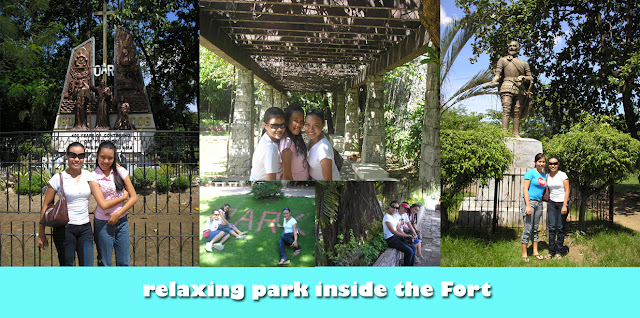
A few meters away from the Sto. Niño Basilica-Magellan’s Cross complex is the Fort San Pedro which was built in 1738 by Spanish and Cebuano laborers under the command of Miguel Lopez de Legazpi, the first Governor-General of the Philippines to repel Muslim raiders. I had the chance to visit this historical place when I stayed in Cebu for my job (see My Adventures – Me As An Engineer and My Homes Away From Home). Inside the Fuerza de San Pedro were a park and a museum that showcases the shipwreck remains of the Spanish galleon, San Diego.


Cebu became a charter province on February 24, 1937 and with this, the Cebu Provincial Capitol was built on the same year during the incumbency of Gov. Sotero Cabahug. It is located at the north end of Osmeña Boulevard. When I worked in Cebu and lived in Escario, I always passed by here everyday.

Aside from the rich history Cebu has, it is also a seat of renowned people. One of these people is the Philippines’ fourth president, his Excellency Sergio Osmeña. After the Philippines’ liberation from the Japanese Occupation during World War II with the aid of the US troops headed by General Douglas MacArthur, Pres. Osmeña restored the Commonwealth government in the country. His term marked the Philippines’ new beginnings. In honor to him, his ancestral house became a museum that is open to public viewing nowadays and called as the Osmeña Museum.


Just steps away from Osmeña Museum is the Fuente Osmeña Circle that is the landmark of Cebu. Public events are being held here that is located right at the very heart of the city.

Now off to the island where Magellan was killed by Lapu-Lapu – the Mactan Island. It is located just a few kilometers from mainland Cebu. In the island were the monument of the great Lapu-Lapu and the Magellan marker which is a tower to commemorate his death. The whole place is commonly called as the Mactan Shrine.

In order for the people to have better and comfortable access to the historic island, a bridge was built in 1970 during the term of Pres. Ferdinand Marcos that was called as the Mactan-Mandaue Bridge. Eventually, traffic jammed due to the growing industries in the big city so another bridge was built in 1999 donated by the Japanese government. And this was named in honor of Senator Marcelo Fernan, a political figure from Cebu City, thus the Marcelo Fernan Bridge.

Then off we go south and there’s this Monastery of the Holy Eucharist at Sibonga. The monastery was built for the Marian devotees and Marian Monks. It is a place of prayer wherein people visit to light their candles for their prayer requests. I, myself tested this by visiting and praying there with my co-reviewees for wisdom to pass the board exam. God answers prayers and all five of us indeed passed the really tough exam.

But Cebu is not just for the Christian community. It is also for the Chinese who had inhabited the land since 1590. Chinese, as they always do, had flourished businesses in Cebu. Once upon a time, there was this old Chinese woman who had dreamt of putting up a temple for their gods. And to keep their faith, the Chinese community supported her in her vision thus the Taoist Temple was built in Beverly Hills, Lahug in 1972. Nowadays, Chinese come to the solemn place for prayer and enlightenment as well as Filipinos. It has also become one of Cebu’s tourist spots wherein you can take scenic pictures but just outside the temples as respect to their gods.

And just recently, a multi-million infrastructure was built in Cebu’s reclaimed area, the Cebu International Convention Center (CICC). It was purposely built in 2005 for the 12th ASEAN Summit and 2nd East Asia Summit in 2007. Leaders from all over Asia came to Cebu. There were presidents, prime ministers, and sultans. It was a pride and honor for Cebu to have had hosted such an international event.

With its historic significances, rich culture, and hospitable people, foreigners just couldn’t exclude Cebu from their list of places to visit. It has a lot to offer including world-class hotels and resorts like the Waterfront, Marriott, Hilton, Shangri-La, etc. World-class shopping is also offered in the city. It has SM and Ayala with designer signature shops to hoard.

 |
| Marriott Hotel |


Cebu indeed is world-class that is why it is called as the “Queen” City of the South. And it is also a great honor to me to have had experienced Cebu for almost two years and for that, I have these
10 Things I Miss About Cebu:
- Sundays at Ayala
- On-Stage (Cinema 1) at Ayala
- Sbarro’s Pizza and Pasta
- Dinners at Krua Thai
- Coffee at Offroads’ rooftop
- Closing times at SM
- Laughters and margaritas at 22nd St.
- Hoarding Watson’s
- Radical talks with my gay friends
- Very long convos with my girl friends
For more information about Cebu, visit www.cebucity.gov.ph.